

Resins are essential materials used across a broad spectrum of industries, shaping everything from coatings and adhesives to advanced composites. Their versatility, strength, and durability stem largely from a foundational chemical process known as cross-linking.
Cross-linking transforms basic polymer chains into interconnected, three-dimensional networks. At the center of this transformation are cross-linking agents, molecular connectors that build strong, permanent bonds between polymer chains and influence the resin’s eventual properties.
Understanding cross-linking agents in resin is key for anyone involved in polymer science, chemical manufacturing, or related industrial fields. Far more than simple ingredients, these agents define a resin’s mechanical performance, chemical resistance, and thermal stability. This guide to cross-linking agents in resin provides a detailed explanation of what these agents are, their function, and their benefits.
What Are Cross-Linking Agents?
At their most basic level, resins consist of individual polymer chains. Initially, these chains exist separately, with no permanent connections between them. In this pre-cross-linked state, resins may be viscous liquids or soft solids, lacking the rigidity and structure required for demanding applications.
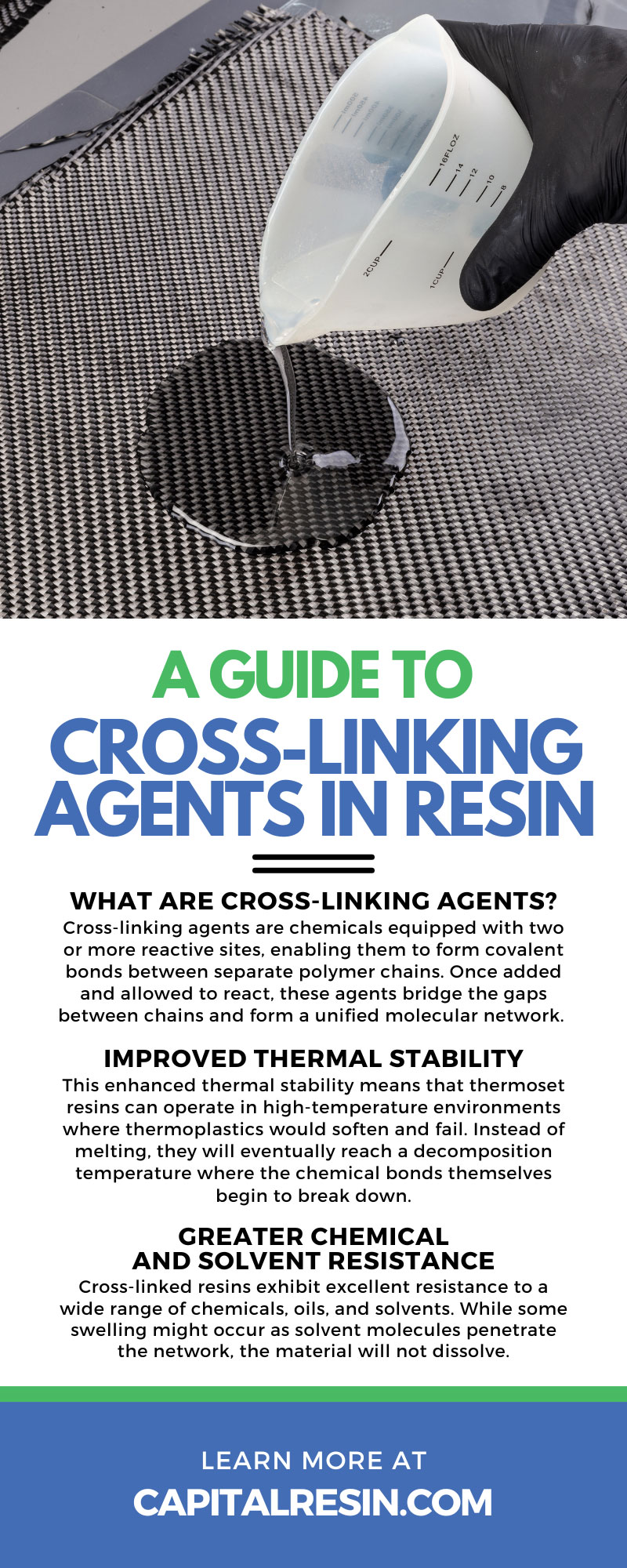
Cross-linking agents are chemicals equipped with two or more reactive sites, enabling them to form covalent bonds between separate polymer chains. Once added and allowed to react, these agents bridge the gaps between chains and form a unified molecular network.
The resulting material is no longer merely a group of independent strands; it’s a solid, interconnected web with enhanced rigidity and stability. Essentially, cross-linking agents function as a “setter,” permanently connecting polymer chains on a molecular scale.
Chemically, cross-linking typically involves agents reacting with specific functional groups, such as hydroxyl, amine, or epoxy groups, on the resin’s polymers. These reactions are central to transitioning resins from thermoplastic, meltable and reshaped by heat, to thermoset, rigid and not able to melt again after curing. You can carefully control the extent of cross-linking, the number of connections within a given area, to adjust properties such as flexibility or hardness.
The Impact of Cross-Linking on Resin Properties
The true value of using cross-linking agents in resin lies in the significant performance enhancements they provide. By creating a robust molecular architecture, the agents improve a wide range of material properties.
Enhanced Mechanical Strength and Durability
One of the most noticeable benefits of cross-linking is a dramatic increase in mechanical strength. The interconnected network is far more resistant to deformation than individual polymer chains. This translates to improvements in the following areas:
- Tensile strength allows the material to resist being pulled apart.
- Hardness establishes a resistance to scratching, indentation, and surface damage.
- Creep resistance slows deformation over time when under a constant load.
With polymer chains locked in place, the material can better withstand physical stress without permanent distortion or failure. This makes cross-linked resins ideal for applications requiring long-term structural integrity and durability.
Improved Thermal Stability
Non-cross-linked polymers have a distinct melting point. When subjected to heating, the chains gain enough energy to slide past one another, and the material turns into a liquid.
Cross-linked polymers don’t have a true melting point. The covalent bonds prevent the chains from flowing, so the material retains its solid form at much higher temperatures.
This enhanced thermal stability means that thermoset resins can operate in high-temperature environments where thermoplastics would soften and fail. Instead of melting, they will eventually reach a decomposition temperature where the chemical bonds themselves begin to break down.
Greater Chemical and Solvent Resistance
Solvents work by surrounding and separating individual polymer chains, causing the material to swell or dissolve. In a cross-linked polymer, the chains are chemically bonded into a single network, and a solvent cannot get in between the chains to pull them apart.
As a result, cross-linked resins exhibit excellent resistance to a wide range of chemicals, oils, and solvents. While some swelling might occur as solvent molecules penetrate the network, the material will not dissolve.
Types of Cross-Linking Agents and Mechanisms
This guide to cross-linking agents in resin addresses the fact that the chemistry of cross-linking covers a wide range of agents and reaction mechanisms. Each suits a specific type of resin.
Addition Cross-Linking
Addition cross-linking is a reaction that involves the cross-linking agent adding directly across sites like double bonds or functional groups on the polymer chain without releasing by-products. Polyurethane and epoxy resin systems often use this mechanism, resulting in high efficiency and, typically, room-temperature processing. The key benefits are processing flexibility and reliable results.
Condensation Cross-Linking
In condensation reactions, the cross-linking agent bridges between polymer chains by reacting with their functional groups, but these reactions create small molecular by-products, such as water or alcohol. Phenolic and certain amino resins rely on this pathway.
Also, by-product removal may require heat to complete the process. This additional step sometimes results in denser and more heat-resistant networks.
Selecting the right type of cross-linking agent depends on the functional groups present on the polymer, such as -OH, -NH₂, or -COOH. Other factors include compatibility with curing temperature, pot life, and end-use requirements. Each chemistry offers a balance between handling, performance, and processing conditions.
Precise and Controlled Manufacturing
Producing consistent, high-quality cross-linked resins hinges on precise management of composition and process. Consider that the ratio of cross-linking agent to resin is a critical factor. Significantly low amounts can lead to an incomplete network and weak spots and inadequate properties, while excess amounts may result in brittleness or other issues, depending on the system.
In addition to composition, careful control of reaction conditions like temperature, pressure, and mixing time is vital. The curing process, whether by addition or condensation mechanism, should be uniform to avoid regions with uneven cross-link densities.
Avoid these errors by partnering with a custom chemical manufacturer, like Capital Resin Corporation. With our rigorous process controls, comprehensive research and development capabilities, and versatile production, we guarantee resin systems reach their full potential. This is especially important in custom and toll manufacturing, where precise adjustment can be necessary to meet the project requirements.
The Science of Cross-Linking in Resin
Cross-linking agents in resin allow manufacturers to produce strong, durable, and heat resistant materials. Their ability to connect individual polymer chains into stable, three-dimensional networks differentiates high-performance thermoset resins from conventional plastics.
What are the benefits of these advances in resin chemistry? A diverse range of cross-linking agents and mechanisms is available, allowing for the precise matching of resin systems to customer and industry requirements.
Success in resin manufacturing depends on selecting the proper cross-linking agent and careful attention to formulation, process precision, and quality control. Understanding the science behind cross-linking agents in resin gives stakeholders greater insight into producing advanced materials with attributes that continue to meet the evolving challenges of countless industrial sectors.